


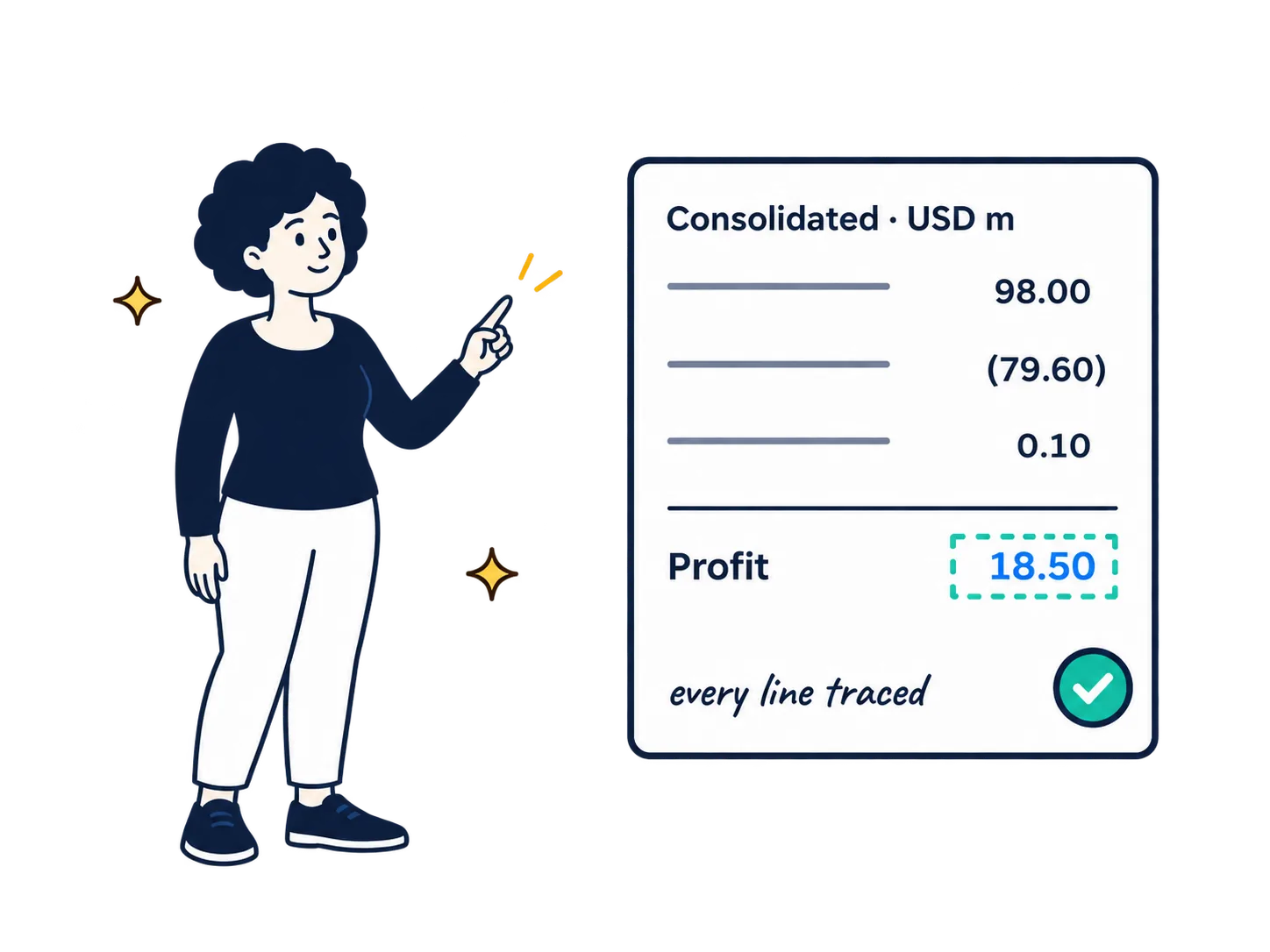
Consolidate every entity, in every GAAP, without the spreadsheet.
Group structure, eliminations, currency translation and non-controlling interest, run from one definition of the group. Each entity reports in its local GAAP, the group consolidates in the parent's, and every number traces back.
A 30-minute walkthrough with the team that builds FinConso.
- IFRS, US GAAP, Ind AS and SFRS(I) in one group
- Multi-GAAP adjustment layer, kept separate
- Rates set per GL account, locked per period
| Entity | NCI % | Opening | Profit | OCI | FCTR | Closing |
|---|---|---|---|---|---|---|
| Middle East FZE 60→76% 14 Aug | 24% | 1,012.4 | 142.6 | (4.1) | (64.7) | 1,086.2 |
| Europe Ltd | 49% | 2,071.3 | 318.4 | (11.7) | 34.9 | 2,412.9 |
| Engineering GmbH | 59.2% | 603.8 | 96.1 | (1.2) | 5.8 | 704.5 |
| Total NCI | 3,687.5 | 557.1 | (17.0) | (24.0) | 4,203.6 |
The problem
Group consolidation in spreadsheets means remapping every trial balance, rebuilding eliminations and proving the translation reserve by hand, every period.
What FinConso does
Group structure, eliminations, currency translation and non-controlling interest, run from one definition of the group. Each entity reports in its local GAAP, the group consolidates in the parent's, and every number traces back.
Capabilities
Everything consolidate needs, in one place.
Multi-GAAP adjustment layer
Keep each subsidiary in its local framework and consolidate under the parent's. GAAP adjustments sit in their own layer, so both views reconcile and neither ledger is touched.
Group structure as at any period
Every entity with its country, currency, framework and year end. Ownership, control and effective interest are held by date, so a mid-year change applies from the day it happened.
Exchange rates at GL level
Each account carries its rate type: closing, average or historical, in line with IAS 21, ASC 830, Ind AS 21 and SFRS(I) 1-21. The translation reserve is provable, not a balancing figure.
NCI calculation
Share of profit, OCI and translation reserve from the ownership percentages, with the roll-forward and the note, under IFRS 10, ASC 810, Ind AS 110 and SFRS(I) 10.
Eliminations and top-side adjustments
Intercompany balances and transactions eliminated from the structure. Top-side adjustments posted with approval and a full trail.
Cost reallocation, CoA merge and integrations
Shared costs allocated on drivers with both views reportable. A global chart of accounts merge maps each entity once, and trial balances arrive from your ERP on a schedule.
See it worked
A consolidation you can check, line by line.
The illustrative Apex group: three entities, three currencies, three frameworks. Select a step.
Group and mapping
Each TB mapped once, versioned by period
| Entity | Currency | Framework | Accounts | Mapped | Status |
|---|---|---|---|---|---|
| Apex Holdings Inc. | USD | US GAAP | 142 | 142 | ✓ |
| Apex India Pvt Ltd | INR | Ind AS | 386 | 386 | ✓ |
| Apex Asia Pte Ltd | SGD | SFRS(I) | 211 | 209 | 2 to map |
Intercompany
Matched by counterparty. Differences explained.
| Balance | Counterparties | Parent | Subsidiary | Difference | Status |
|---|---|---|---|---|---|
| Management fees | Parent ↔ India | 1.80 | 1.80 | 0.00 | ✓ |
| Management fees | Parent ↔ Asia | 1.20 | 1.20 | 0.00 | ✓ |
| Receivable / payable | Parent ↔ India | 0.30 | 0.30 | 0.00 | ✓ |
| Receivable / payable | Parent ↔ Asia | 0.40 | 0.38 | 0.02 | Review |
Elimination entries · USD m
Currency translation and NCI
Rates held at GL level and locked for the period. The translation reserve is calculated entity by entity, and NCI follows the ownership structure.
| Rate per USD | Opening | Average | Closing |
|---|---|---|---|
| INR | 82.00 | 83.00 | 84.00 |
| SGD | 1.36 | 1.35 | 1.30 |
| NCI in Apex Asia (20%) · USD m | Amount |
|---|---|
| Opening NCI | 7.15 |
| Share of profit (20% of 6.50) | 1.30 |
| Share of translation difference | 0.38 |
| Closing NCI | 8.83 |
| Translation reserve · USD m | India | Asia |
|---|---|---|
| Opening net assets at opening rate | 70.85 | 35.74 |
| Profit at average rate | 10.00 | 6.40 |
| Translation difference | (1.80) | 1.89 |
| Closing net assets at closing rate | 79.05 | 44.03 |
Consolidated statements with drill‑down
Consolidated statements in the group framework. Select any line to trace it to the entity, the exchange rate and the elimination behind it.
Select a line to see where it came from.
| Consolidated income statement · US GAAP | USD m |
|---|---|
| 98.00 | |
Apex Holdings Inc.3.00 Apex India Pvt Ltd · INR 4,150.0 at 83.0050.00 Apex Asia Pte Ltd · SGD 64.80 at 1.3548.00 Elimination E1 · management fees(3.00) | |
| (79.60) | |
Apex Holdings Inc.(1.00) Apex India Pvt Ltd · INR 3,320.0 at 83.00(40.00) Apex Asia Pte Ltd · SGD 56.16 at 1.35(41.60) Elimination E1 · management fees3.00 | |
| 0.10 | |
Apex Asia: SFRS(I) 16 cost 1.20 replaced by ASC 842 lease cost 1.100.10 | |
| Profit for the period | 18.50 |
| Attributable to owners of the parent | 17.20 |
| Attributable to non-controlling interest | 1.30 |
| Translation differences (OCI): India (1.80), Asia 1.89 | 0.09 |
| Total comprehensive income | 18.59 |
| Owners 16.91 · NCI 1.68 | |
How it works
Three steps, every period.
- 1
Define the group once
Entities, currencies, year ends and holdings, effective from the dates they apply.
- 2
Bring the numbers in
Trial balances synced from the ERP or uploaded, mapped once to the group chart.
- 3
Run, re-run and prove
Eliminations, translation and NCI applied in a queue. Re-run as often as the close needs.
Controls
Review and approval, built in.
Group structure and mappings versioned by period, with maker-checker on every change
Exchange rates locked for the period before the consolidation runs
Every elimination and adjustment posted as a reviewable journal with its evidence
Every action is recorded in the audit trail with who, when and what changed. Security and trust →
AI in Consolidate
Agents that do the legwork.
Transaction matching
Matches bank lines, intercompany entries and sub-ledgers to the GL, and explains what is left.
Reviewer approves before postingAnomaly detection
Flags unusual journals, balances and movements before review.
Reviewer approves before postingGL correction suggestions
Proposes the correcting journal for a reconciling difference, with the evidence it used.
Reviewer approves before postingImplementation
Live after a parallel run, not on trust.
We validate FinConso against your own last close before you rely on it.
- 1
Scope
Entities, frameworks, reports and integrations agreed, with a written plan and owners on both sides.
- 2
Connect or upload
Trial balances from your accounting systems by connector or upload template. Your books stay where they are.
- 3
Map and configure
Group chart, mappings, ownership, rates and elimination rules set up and approved by your team.
- 4
Parallel run
FinConso runs alongside your last close, and every difference with your existing numbers is explained before go-live.
- 5
Go live
Sign-off by your controller, then the first close on FinConso with our team alongside.
Capability stories
How we handle the hard parts.
Proving the translation reserve, not plugging it
How rate types at GL level turn the foreign currency translation reserve from a balancing figure into a schedule.
Read the capability →A group close checklist that actually holds
Owners, due dates, dependencies and sign-off: the four things a checklist needs to stop the close depending on memory.
Read the capability →Works with
Connected to the rest of the platform.
Report
Statements, notes and filings drawn from the same ledger as the consolidation.
Explore →Close & reconcile
Every entity and period runs to a standard checklist with owners, due dates and sign-off.
Explore →Schedules
The technical accounting sub-ledgers run inside FinConso and feed the statements and notes directly, so the schedules your auditor asks for are produced, not rebuilt.
Explore →Order to cash
Credit, invoicing, collections, cash application and deductions in one flow, connected to the ledger and the cash forecast.
Explore →FAQ
Consolidate questions
Anything else, ask us in the demo. You will be talking to the people who build it.
How does FinConso handle a mid-year change in shareholding?
Ownership, control and effective interest are held as at any date. Change a shareholding mid-year and the consolidation and NCI calculation pick it up from that date. There is no second spreadsheet to keep in step.
Can different accounts use different exchange rates?
Yes. Each GL account carries its rate type: closing, average or historical. Rates are recorded and locked for the period, and the translation reserve proof is produced by entity.
Can subsidiaries report under different frameworks?
Yes. Each entity is set up with its own framework. The multi-GAAP adjustment layer converts local figures to the group framework, so a US parent with Indian and Singapore subsidiaries, for example, sees both views and the bridge between them.
How long does a large consolidation take to run?
Large groups run in a queue, so a twenty-entity consolidation does not hold up a screen. Re-run it as many times as the close needs.
Does it handle indirect holdings?
Yes. Effective interest is calculated through the chain of holdings, and NCI follows from it.
How is FinConso priced?
Pricing is tailored to your group. It depends on the number of entities, the modules you use and the integration and implementation work involved. You get a written proposal after the demo.
How long does implementation take?
It depends on the number of entities, frameworks and integrations. We agree a dated plan after scoping, and you go live only after a parallel run against your last close.
Structured pilot · no cost
Evaluate FinConso on a representative sample of your group.
For qualified groups: share one quarter's trial balances and your entity structure under a mutual NDA, and we return the consolidated pack. You keep the output, whether or not you go ahead.
- 1
Send one quarter
Trial balances by entity, your entity tree and chart of accounts. Any framework, any currency.
- 2
We run it in FinConso
Mapping, eliminations, translation, NCI and the multi-GAAP bridge, on your structure.
- 3
You keep the pack
Consolidated statements, translation reserve proof and NCI schedule, with the linked workbook.
Book a demo
See the consolidation workflow, from trial balance to signed statement.
A 30-minute walkthrough with the people who build FinConso.
- Entities, eliminations, translation, NCI and the multi-GAAP layer, run live on a sample group.
- Every consolidated figure drilled back to the entity and account it came from.
- Questions on IFRS, US GAAP, Ind AS or SFRS(I) answered by the team that builds the product.
- Want to test it on your own numbers? See how the structured pilot works.
Online booking opens soon.
The booking form is being set up. Please check back shortly.